


Python虚拟机中复数的实现原理是什么
复数数据结构在cpython当中对于复数的数据结构实现如下所示:typedefstruct{doublereal;doubleimag;}Py_complex;#definePyObject_HEADPyObjectob_base;typedefstruct{PyObject_HEADPy_complexcval;}PyComplexObject;typedefstruct_object{_PyObject_HEAD_EXTRAPy_ssize_tob_refcnt;struct_typeobject*o
复数数据结构
在 cpython 当中对于复数的数据结构实现如下所示:
typedef struct {
    double real;
    double imag;
} Py_complex;
#define PyObject_HEAD                   PyObject ob_base;
typedef struct {
    PyObject_HEAD
    Py_complex cval;
} PyComplexObject;
typedef struct _object {
    _PyObject_HEAD_EXTRA
    Py_ssize_t ob_refcnt;
    struct _typeobject *ob_type;
} PyObject;
上面的数据结构图示如下:
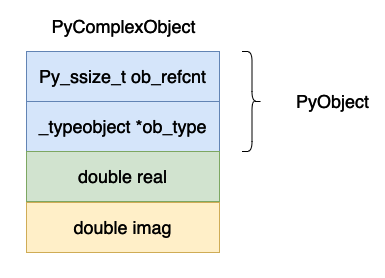
复数的数据在整个 cpython 虚拟机当中来说应该算是比较简单的了,除了一个 PyObject 头部之外就是实部和虚部了。
ob_refcnt,表示对象的引用记数的个数,这个对于垃圾回收很有用处,后面我们分析虚拟机中垃圾回收部分在深入分析。
ob_type,表示这个对象的数据类型是什么,在 python 当中有时候需要对数据的数据类型进行判断比如 isinstance, type 这两个关键字就会使用到这个字段。
real,表示复数的实部。
imag,表示复数的虚部。
复数的操作
复数加法
下面是 cpython 当中对于复数加法的实现,为了简洁删除了部分无用代码。
static PyObject *
complex_add(PyObject *v, PyObject *w)
{
    Py_complex result;
    Py_complex a, b;
    TO_COMPLEX(v, a); // TO_COMPLEX 这个宏的作用就是将一个 PyComplexObject 中的 Py_complex 对象存储到 a 当中
    TO_COMPLEX(w, b);
    result = _Py_c_sum(a, b); // 这个函数的具体实现在下方
    return PyComplex_FromCComplex(result); // 这个函数的具体实现在下方
}

// 真正实现复数加法的函数
Py_complex
_Py_c_sum(Py_complex a, Py_complex b)
{
    Py_complex r;
    r.real = a.real + b.real;
    r.imag = a.imag + b.imag;
    return r;
}

PyObject *
PyComplex_FromCComplex(Py_complex cval)
{
    PyComplexObject *op;

    /* Inline PyObject_New */
    // 申请内存空间
    op = (PyComplexObject *) PyObject_MALLOC(sizeof(PyComplexObject));
    if (op == NULL)
        return PyErr_NoMemory();
    // 将这个对象的引用计数设置成 1
    (void)PyObject_INIT(op, &PyComplex_Type);
    // 将复数结构体保存下来
    op->cval = cval;
    return (PyObject *) op;
}
上面代码的整体过程比较简单:
首先先从 PyComplexObject 提取真正的复数部分。
将提取到的两个复数进行相加操作。
根据得到的结果在创建一个 PyComplexObject 对象,并且将这个对象返回。
复数取反
复数取反操作就是将实部和虚部取相反数就可以了,这个操作也比较简单。
static PyObject *
complex_neg(PyComplexObject *v)
{
    Py_complex neg;
    neg.real = -v->cval.real;
    neg.imag = -v->cval.imag;
    return PyComplex_FromCComplex(neg);
}

PyObject *
PyComplex_FromCComplex(Py_complex cval)
{
    PyComplexObject *op;

    /* Inline PyObject_New */
    op = (PyComplexObject *) PyObject_MALLOC(sizeof(PyComplexObject));
    if (op == NULL)
        return PyErr_NoMemory();
    (void)PyObject_INIT(op, &PyComplex_Type);
    op->cval = cval;
    return (PyObject *) op;
}
Repr 函数
我们现在来介绍一下一个有趣的方法,就是复数类型的 repr 函数,这个和类的 __repr__ 函数是作用是一样的我们看一下复数的输出是什么:
>>> data = complex(0, 1)
>>> data
1j
>>> data = complex(1, 1)
>>> data
(1+1j)
>>> print(data)
(1+1j)
复数的 repr 对应的 C 函数如下所示:
static PyObject *
complex_repr(PyComplexObject *v)
{
    int precision = 0;
    char format_code = 'r';
    PyObject *result = NULL;

    /* If these are non-NULL, they'll need to be freed. */
    char *pre = NULL;
    char *im = NULL;

    /* These do not need to be freed. re is either an alias
       for pre or a pointer to a constant.  lead and tail
       are pointers to constants. */
    char *re = NULL;
    char *lead = "";
    char *tail = "";
    // 对应实部等于 0 虚部大于 0 的情况
    if (v->cval.real == 0. && copysign(1.0, v->cval.real)==1.0) {
        /* Real part is +0: just output the imaginary part and do not
           include parens. */
        re = "";
        im = PyOS_double_to_string(v->cval.imag, format_code,
                                   precision, 0, NULL);
        if (!im) {
            PyErr_NoMemory();
            goto done;
        }
    } else {
        /* Format imaginary part with sign, real part without. Include
           parens in the result. */
        // 将实部浮点数变成字符串
        pre = PyOS_double_to_string(v->cval.real, format_code,
                                    precision, 0, NULL);
        if (!pre) {
            PyErr_NoMemory();
            goto done;
        }
        re = pre;
        // 将虚部浮点数变成字符串
        im = PyOS_double_to_string(v->cval.imag, format_code,
                                   precision, Py_DTSF_SIGN, NULL);
        if (!im) {
            PyErr_NoMemory();
            goto done;
        }
        // 用什么括号包围起来
        lead = "(";
        tail = ")";
    }
    result = PyUnicode_FromFormat("%s%s%sj%s", lead, re, im, tail);
  done:
    PyMem_Free(im);
    PyMem_Free(pre);

    return result;
}
我们现在修改源程序将上面的 () 两个括号变成 [],编译之后执行的结果如下所示:
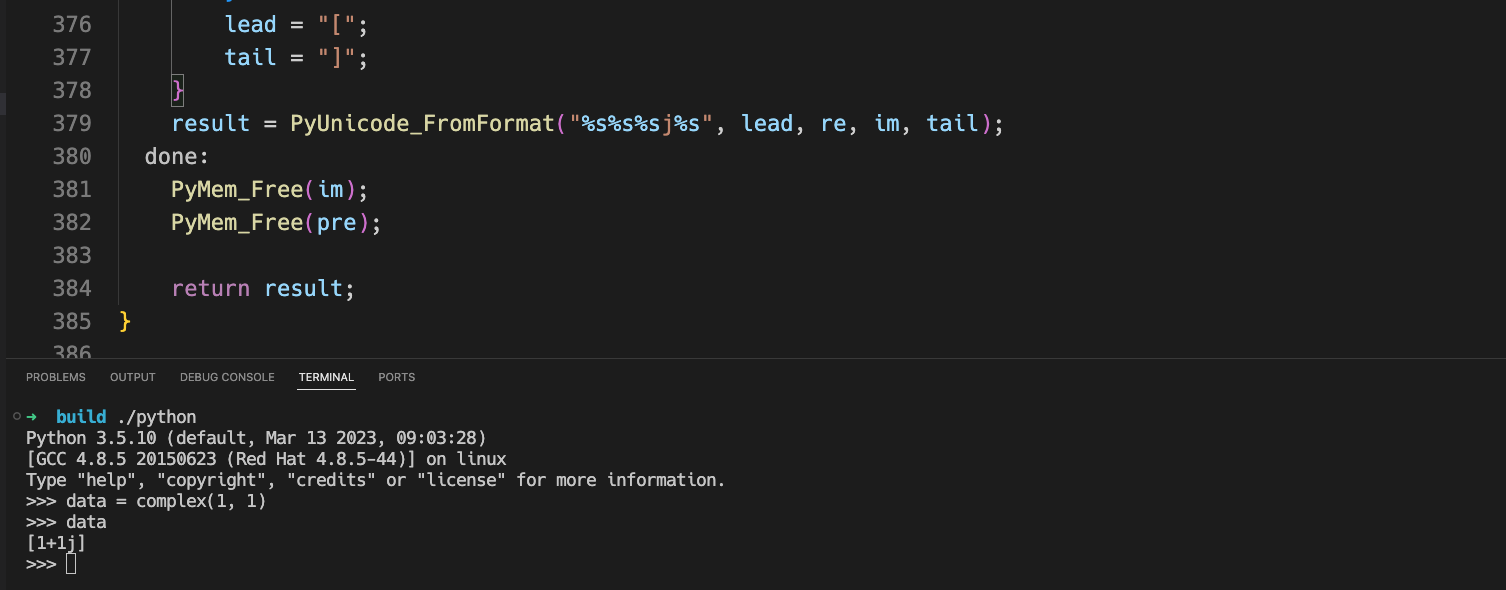
可以看到括号变成了 [] 。










IntelliJ IDEA 是 JetBrains 推出的专业集成开发环境,重点服务于 Java、Kotlin 与 JVM 项目开发。软件集成代码补全、静态检查、重构、调试、测试、版本控制及构建工具,并可借助插件扩展语言和框架支持。

JetBrains PyCharm 是面向 Python 开发者的集成开发环境,提供智能补全、代码检查、重构、调试、测试、版本控制及虚拟环境管理功能。Mac 版兼容 Intel 与 Apple 芯片,核心功能可免费使用。

JetBrains WebStorm 是面向 JavaScript、TypeScript 和现代 Web 技术的专业集成开发环境,可智能理解项目结构,提供代码补全、重构、错误检查、运行调试、测试及 Git 工具。

Adobe After Effects 是面向动态图形、影视特效与视频合成的专业创作软件。它提供关键帧动画、遮罩抠像、运动跟踪、三维空间、文字动画和表达式等工具,并可与 Premiere Pro、Photoshop、Illustrator

Adobe Audition 是面向播客、影视后期、音乐制作及内容创作者的专业音频工作站,提供波形精修、多轨录制与混音、频谱编辑、降噪修复、响度匹配和效果处理工具,并可与 Adobe Premiere 协同完成视频声音制作。

Adobe Bridge 是面向摄影师、设计师及内容团队的免费数字资产管理工具,可集中预览照片、视频和 Adobe 项目文件,并利用评级、标签、关键词、元数据、筛选与收藏集完成分类检索。它还支持批量重命名、格式导出、相机导入及 Camera

Adobe Illustrator 是 Adobe 推出的专业矢量图形设计软件,适合在 Mac 上制作标志、图标、插画、包装、信息图及印刷版面。它以路径和锚点构建可无损缩放的图形,并提供钢笔、形状、文字、图像描摹、渐变、画板及生成式功能。

Adobe InDesign 是面向印刷品与数字出版物的专业版面设计软件,可在 Mac 上制作书籍、杂志、宣传册、海报、报告及交互式文档。它提供精细的文字样式、网格、母版、长文档管理和印前输出能力。

Adobe Lightroom Classic 是面向桌面摄影工作流的照片管理与后期处理软件,可将原始照片保存在本地硬盘,通过目录、关键词、评分和收藏夹高效整理图库,并提供 RAW 冲印、蒙版、镜头校正、批量同步及多格式导出等功能。

Adobe Media Encoder 是 Adobe 推出的专业音视频编码与转码工具,可通过队列、预设和监视文件夹批量完成格式转换、代理文件创建及多平台成片输出,并与 Premiere Pro、After Effects 等软件紧密协作。

Adobe Photoshop 是面向摄影师、设计师和内容创作者的专业图像处理软件,提供图层、蒙版、选区、修复、调色、文字排版、智能对象及生成式编辑等能力。Mac 版支持 Intel 与 Apple Silicon 处理器。

Adobe Premiere Pro 是面向专业视频制作的非线性剪辑软件,提供多轨时间线、调色、音频处理、字幕、代理工作流和多格式输出能力,并可与 After Effects、Audition、Photoshop 及 Frame.io 协同

JetBrains IntelliJ IDEA 是以 Java、Kotlin 和 JVM 项目为核心的专业集成开发环境,提供智能补全、代码检查、安全重构、调试、测试、版本控制及构建工具集成。统一发行版的核心功能可免费用于商业和非商业项目,

PhpStorm 是 JetBrains 面向 PHP 与现代 Web 开发打造的专业集成开发环境,提供代码补全、静态检查、重构、调试、测试、数据库、版本控制及前端语言支持。Windows 用户可直接下载安装程序,

PyCharm 是 JetBrains 推出的 Python 集成开发环境,提供智能代码补全、错误检查、重构、调试、测试、Git、终端及 Jupyter Notebook 支持。统一版安装后可体验 30 天 Pro 功能,

WebStorm 是 JetBrains 面向 JavaScript、TypeScript 和现代 Web 技术打造的集成开发环境。它提供项目级代码分析、智能补全、安全重构、导航搜索,并集成调试、测试、终端、Git 与常用前端工具,

Adobe Photoshop 是面向摄影师、设计师和内容创作者的专业图像处理工具,可在 Windows 上完成照片修饰、选区抠图、图层合成、文字排版、绘画及生成式编辑。软件采用订阅授权,由 Creative Cloud 管理安装、更新与许

Adobe InDesign 是面向印刷与数字出版的专业页面排版工具,可制作书籍、杂志、宣传册、海报、交互式 PDF 和电子书。它提供精细的文字样式、多页面管理、印前检查及多格式输出能力,并能与 Photoshop、Illustrator

Adobe Illustrator 是用于绘制矢量图形、插画、图标、徽标和版式的专业设计工具。它以路径和锚点为核心,作品放大后仍能保持清晰,并提供画板、文字、渐变、图像描摹及精确变换等功能,适合品牌视觉、印刷物料、数字界面和商业插画创作。

Adobe Bridge 是 Adobe 推出的创意资产管理工具,可集中预览、分类和查找照片、视频、PDF及多种设计文件,并支持元数据、关键词、评级、批量重命名和格式导出。它可与 Photoshop、Illustrator 等应用衔接,

Adobe Lightroom Classic 是面向 Windows 桌面摄影工作流的照片管理与无损编辑工具,可通过目录集中整理大型图库,并完成 RAW 显影、局部蒙版、批量调整、打印和多格式导出。它强调本地文件管理与精细控制,

Adobe Acrobat Pro 是面向专业 PDF 工作的综合解决方案,可在 Windows 中创建、编辑、转换、比较、整理和保护文档,并支持表单、电子签名、扫描件文字识别及敏感信息永久遮盖。订阅还包含网页、移动服务和云端协作能力,

Adobe After Effects 是面向动态图形、动画与影视视觉特效制作的专业工具,可完成关键帧动画、图层合成、遮罩跟踪、抠像、文字动画和二维三维元素整合。Windows 版通过 Adobe Creative Cloud 安装及更新,

Adobe Media Encoder 是 Adobe 面向视频与音频制作流程提供的专业编码和转码工具,可批量处理媒体文件、创建代理、套用输出预设并监控文件夹自动执行任务。它与 Premiere、After Effects、Audition